Resumo da Notícia
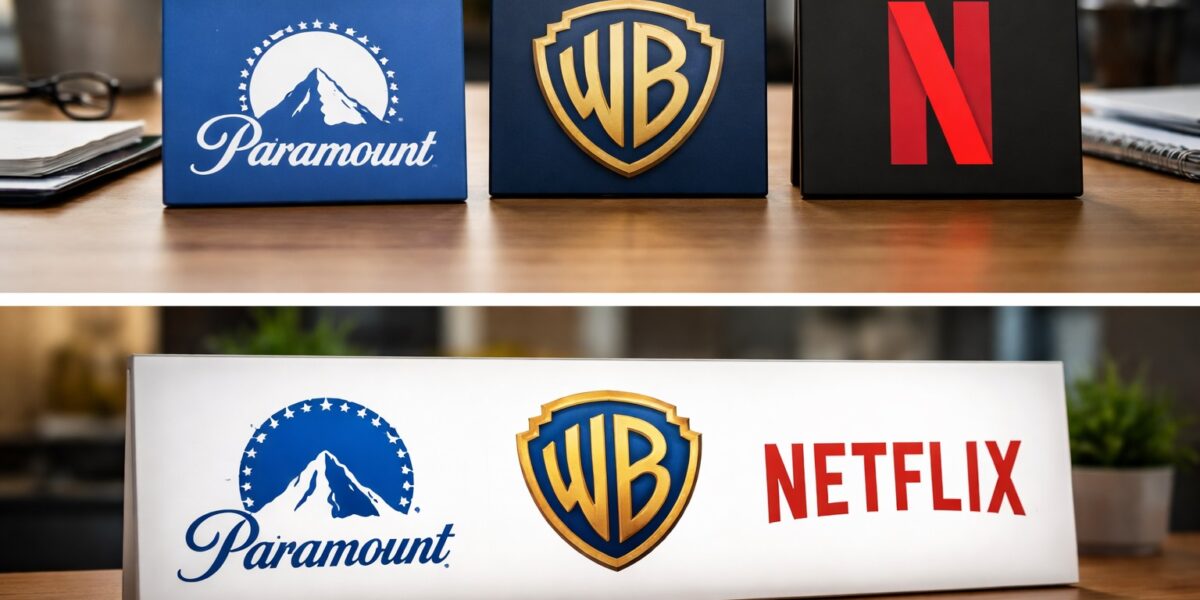
The months-long battle for Warner Bros. Discovery reached a decisive turning point on Thursday (26) after Netflix formally refused to raise its bid, effectively exiting the race to acquire one of Hollywood’s most iconic studios. With Netflix stepping aside, Paramount Skydance now stands as the clear frontrunner in a transaction that has reshaped expectations across the entertainment and financial markets.
Wall Street reacted immediately. Netflix shares jumped roughly 10% in after-hours trading, a strong signal that investors viewed the decision not as a retreat, but as a disciplined move that protected shareholder value in an increasingly expensive and risky bidding war.

Earlier in the day, Warner Bros. Discovery informed the market that Paramount Skydance’s revised proposal — $31 per share — surpassed Netflix’s standing offer of $27.75 per share for Warner’s studio and streaming assets. Matching that bid would have required Netflix to abandon its long-standing capital discipline, something the company made clear it was unwilling to do.
In a public statement released through its corporate newsroom — available in full via Netflix’s official announcement — the company laid out its reasoning in unusually direct terms.
“We have always been disciplined, and at the price required to match Paramount Skydance’s latest offer, the transaction is no longer financially attractive; therefore, we are declining to match Paramount Skydance’s proposal,” Netflix said, leaving little room for ambiguity about its stance.
The company also confirmed its withdrawal to Reuters. Procedurally, Warner Bros. Discovery’s board must now formally terminate the existing agreement with Netflix before approving the Paramount Skydance offer, a step that appears increasingly likely.
Why Netflix chose to step back
Behind the scenes, the decision was driven by economics rather than pride. A Netflix adviser, speaking on condition of anonymity, said the company was urged to walk away once it became clear the bidding had crossed into irrational territory.
According to the adviser, Netflix found itself competing against a bidder willing to pay a price untethered from traditional valuation logic. The remark that captured the moment best came in the form of a blunt metaphor: “There’s no point playing Russian roulette with someone who isn’t going to spin the cylinder.”
The reference was to Larry Ellison, co-founder, executive chairman and chief technology officer of Oracle, and the father of David Ellison, chief executive of Paramount. Ellison’s deep pockets and strategic interest in the deal fundamentally altered the competitive landscape, making it far harder for Netflix to justify staying in the race.
From Netflix’s perspective, preserving financial flexibility outweighed the prestige of owning Warner’s legendary brands.
Regulatory headwinds loom large
The Paramount–Warner tie-up is not just a massive corporate transaction; it would merge two major Hollywood studios, two global streaming platforms — HBO Max and Paramount+ — and two influential news operations, CNN and CBS. That concentration of power virtually guarantees intense antitrust scrutiny.
Despite the Ellison family’s known political connections to President Donald Trump, analysts widely expect regulators in Washington, as well as authorities abroad and in U.S. states such as California, to examine the deal closely.
Democratic senators Elizabeth Warren, Bernie Sanders and Richard Blumenthal have already voiced public concerns, warning that political favoritism could distort the approval process and undermine competition.
Anticipating those risks, Paramount strengthened its revised offer. The company increased the breakup fee payable if regulatory approval fails from $5.8 billion to $7 billion, while significantly boosting its equity commitment.
The Ellison Trust is now pledging $45.7 billion in equity, up from $43.6 billion previously, including additional funds to meet Paramount’s banking solvency requirements. On the debt side, Bank of America Merrill Lynch, Citi and Apollo expanded their financing package to $57.5 billion, compared with an earlier $54 billion commitment.
Pressure from investors and Netflix’s long game
Investor dynamics also played a role. Activist firm Ancora Holdings, a minority shareholder in Warner Bros. Discovery, has intensified pressure on management, arguing that the company failed to engage adequately with Paramount during the process.
Netflix, for its part, used its statement — signed by co-CEOs Ted Sarandos and Greg Peters — to underscore that it is not retreating from growth. The company emphasized that its core business remains healthy, profitable and organically expanding, driven by its content library and platform strength.
Netflix reiterated plans to invest approximately $20 billion in films and series this year, alongside the resumption of its share buyback program, consistent with its capital allocation policy.
While thanking Warner executives, including David Zaslav and Gunnar Wiedenfels, for what it called a “fair and rigorous process,” Netflix framed the acquisition as a strategic option rather than a necessity. In its own words, the deal was always a “nice-to-have at the right price,” not something to be pursued at any cost.
