Resumo da Notícia
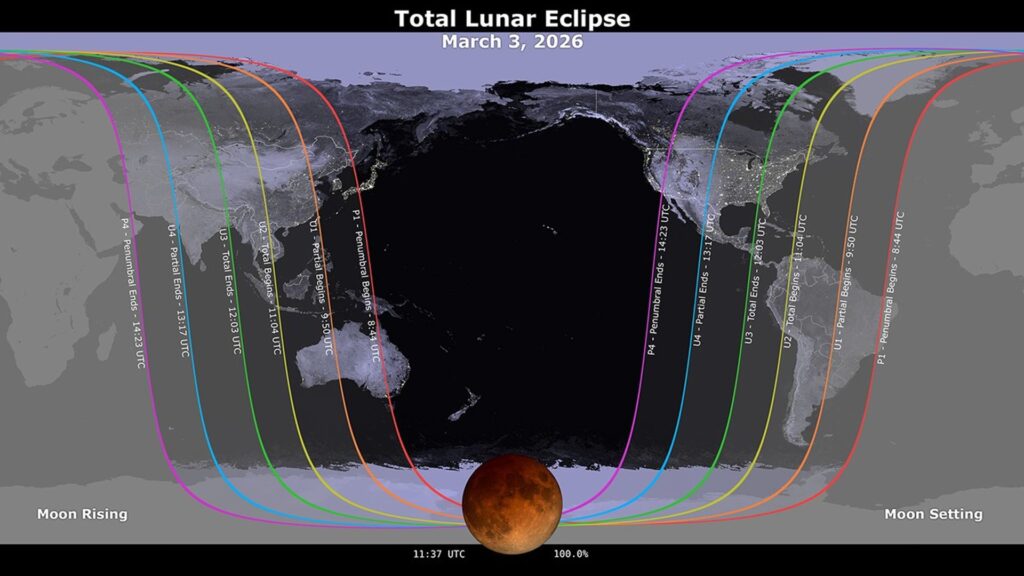
Skywatchers across the United States are getting one of the year’s biggest astronomy events overnight into early Tuesday: a total lunar eclipse, commonly called a blood moon. NASA says the eclipse will be visible in the early morning across North and Central America and far western South America, while eastern Asia and Australia will see it Tuesday evening. Africa and Europe will miss out on this one.
The timing is what makes this event special for U.S. viewers. According to NASA, the eclipse begins with the subtle penumbral phase at 3:44 a.m. Eastern / 12:44 a.m. Pacific, the partial eclipse starts at 4:50 a.m. Eastern / 1:50 a.m. Pacific, and totality — when the moon is fully inside Earth’s darkest shadow — begins at 6:04 a.m. Eastern / 3:04 a.m. Pacific. Totality ends at 7:03 a.m. Eastern / 4:03 a.m. Pacific, with the full event wrapping up later in the morning.

This is also not the kind of event skywatchers can casually put off for next year. The Associated Press reports there won’t be another total lunar eclipse until late 2028, making this the last chance for several years to see the moon fully turn red in Earth’s shadow.
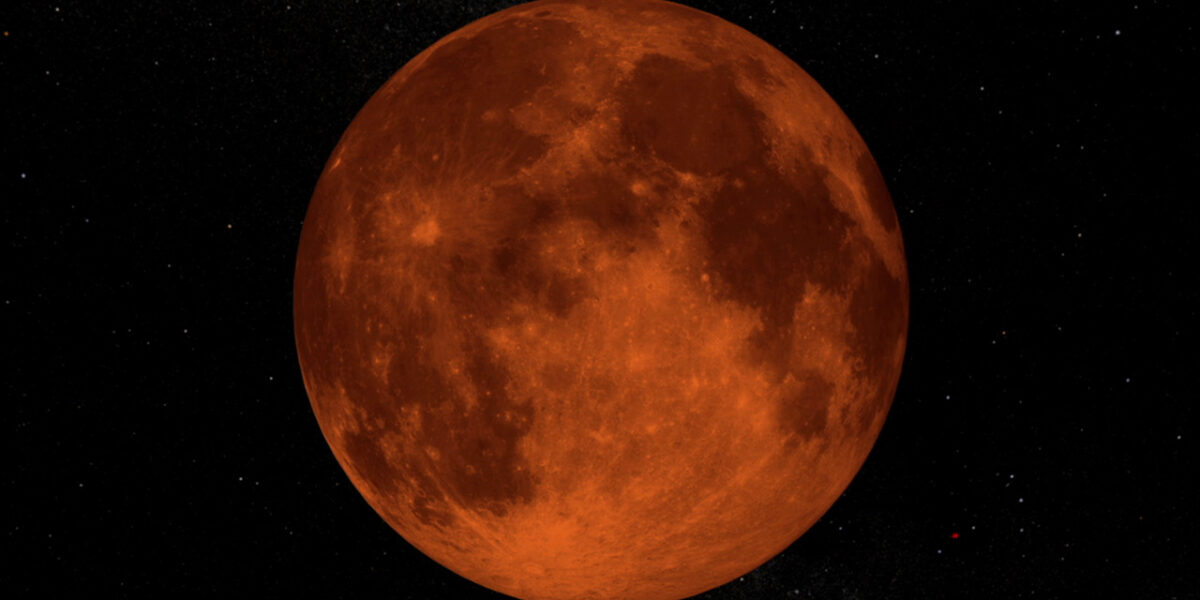
The “blood moon” nickname comes from the color, not from any change in the moon itself. During a total lunar eclipse, Earth moves directly between the sun and the full moon, blocking most sunlight from reaching the lunar surface. What does get through is filtered through Earth’s atmosphere, which bends and scatters shorter wavelengths while allowing more red and orange light to reach the moon. NASA describes it as if the world’s sunrises and sunsets are being projected onto the lunar surface at once.
Unlike a solar eclipse, this one does not require special eye protection. NASA says a lunar eclipse can be watched safely with the naked eye, though binoculars or a telescope can make the red glow and shadow details much more dramatic. The best viewing conditions will come from a dark spot away from bright city lights, with a clear line of sight to the moon.
There is another key difference from the 2024 total solar eclipse that made headlines across the U.S.: there is no narrow path of totality for a total lunar eclipse. Earth’s shadow is large enough to cover the whole moon, so anyone on the night side of the planet within the visibility zone can see the event, assuming weather conditions cooperate.
The March full moon itself is also notable. Space.com notes that the full moon reaches peak illumination at 6:38 a.m. Eastern on March 3, and this month’s full moon is traditionally known as the Worm Moon. But for most viewers, the main event will happen earlier, when the moon darkens and shifts into that unmistakable copper-red color during totality.
For American viewers, the practical advice is simple: set an alarm, check the local sky conditions, and be outside before the partial phase deepens. If skies are clear, this will be one of the most photogenic celestial events of 2026 — and one that will not come back in full form for quite a while.