Summary
A new dispute over battlefield claims has added to the volatility of the Middle East crisis after Iran said it had struck the USS Abraham Lincoln with four ballistic missiles. The claim, attributed to Iran’s Islamic Revolutionary Guard Corps, was presented as part of a broader escalation against what Tehran describes as joint U.S.-Israeli military action.
Washington quickly rejected the report.

In a direct response, U.S. Central Command said the carrier was not hit and insisted the missiles launched by Iran did not come close to the ship. American officials also said the USS Abraham Lincoln remains in action and continues to launch aircraft as part of ongoing operations in the region.
The clash over what happened to the carrier reflects a wider pattern in the conflict: military escalation is now unfolding alongside an aggressive battle over narrative, symbolism and deterrence.
Iran tries to project strength as conflict widens
Iran’s version of events was framed as more than a tactical strike. The message coming from Tehran suggested that the confrontation has entered a more dangerous phase, one in which American assets at sea could become direct targets.
That matters because an aircraft carrier is not just a military platform. It is one of the clearest symbols of U.S. power projection. Any credible claim that such a vessel had been successfully targeted would instantly reshape the political and military meaning of the confrontation.
Even without outside confirmation, the announcement served a purpose. It allowed Iran to portray itself as capable of reaching one of the most protected assets in the U.S. arsenal and to signal that retaliation may not remain limited to land-based or regional targets.
U.S. moves quickly to shut down the claim
The American denial was immediate and unusually blunt. By saying the missiles “didn’t even come close,” CENTCOM was not merely disputing the extent of damage. It was rejecting the entire premise of the Iranian account.
That kind of response is significant. In moments of fast-moving military crisis, public statements like this are often aimed at multiple audiences at once: adversaries, allies, financial markets, regional governments and domestic public opinion.
By stressing that the USS Abraham Lincoln continues to operate normally, Washington is trying to preserve the image of uninterrupted capability and to avoid any perception that Iran has managed to pierce American defenses at sea.
Why the Abraham Lincoln matters so much
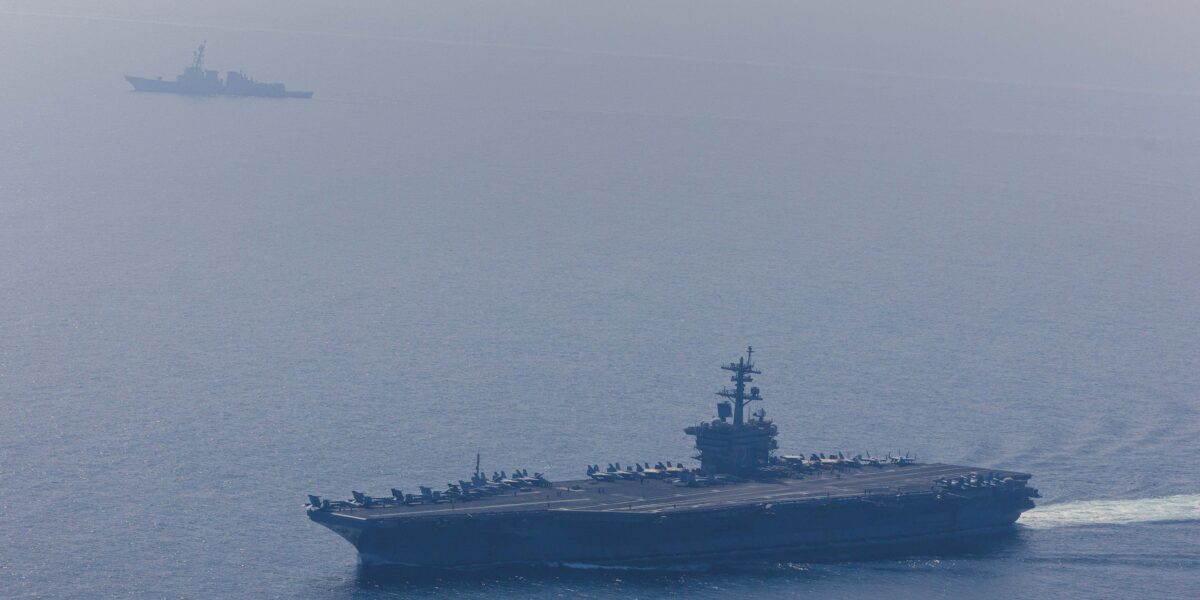
The USS Abraham Lincoln occupies a central role in the current regional balance. Deployed near Iran as tensions escalated, the carrier has become one of the most visible elements of the American military posture in the Middle East.
Because of that, even an unverified claim involving the ship carries strategic weight. If Iran can convince audiences that it threatened or struck the vessel, it strengthens the image of resistance and reach. If the United States can convincingly dismiss the claim, it preserves deterrence and reassures partners that its core assets remain secure.
That is why this episode is important even before independent confirmation emerges.
No independent proof has surfaced so far
At this stage, the public record remains divided between two official stories. Iran says the ship was hit. The United States says it was not.
There has been no independently verified evidence showing that the carrier suffered damage. Until satellite imagery, intelligence assessments or additional official disclosures emerge, the incident remains a contested claim rather than an established battlefield fact.
That uncertainty is now part of the story itself. In regional wars, especially those involving multiple state actors, perception can influence escalation almost as much as physical damage.
A dangerous sign of where the war may be headed
Whether the missiles came close or not, the fact that an American aircraft carrier is now at the center of public claims from Tehran shows how quickly the confrontation is expanding.
The war is no longer confined to strikes inside Iran or retaliatory missile launches against fixed regional targets. It is moving into a phase where both sides are testing not only military limits, but also each other’s willingness to raise the stakes in public.
If that trend continues, the risk of miscalculation will grow sharply.
For now, the core reality is straightforward: Iran claims it hit the USS Abraham Lincoln. The United States says that never happened. In the current Middle East crisis, that contradiction alone is enough to keep tensions elevated.